
Blog

Best ARC Coating Technology Suppliers in China

Choosing among the Best ARC Coating Technology Suppliers in China takes more than comparing prices or browsing polished product photos. ARC Coating Technology generally refers to anti-reflective coating processes that reduce unwanted reflections on optical surfaces. For buyers, performance depends on the application, substrate, coating design, and production controls. Small details matter.

A useful supplier review looks at actual capabilities: available coating equipment, supported lens or glass sizes, thickness control, and coating uniformity across a batch. Ask how adhesion, abrasion resistance, and optical performance are tested, and request relevant reports for the intended product. Clear answers are a good sign. Vague claims deserve follow-up. A sample coated part can reveal color shifts, edge coverage, or surface marks that a brochure may not show.

This guide considers supplier experience, technical communication, quality documentation, customization, and delivery reliability. It also encourages buyers to compare like with like: specifications should match the same substrate, test method, and use conditions. Published data can help, but it cannot replace a production trial. Some supplier information may be incomplete, and that should be acknowledged rather than guessed away. A careful shortlist, followed by sample testing and direct discussion, offers a more dependable basis for selecting an ARC coating partner in China.
Best ARC Coating Technology Suppliers in China

Understanding Anti-Reflective Coating Technology and Its Applications

Anti-reflective (AR) coatings reduce surface reflections and help more light pass through glass or other optical materials. They use thin film layers to control how reflected light waves interact. A carefully designed single layer can work well within a specific wavelength range. Multilayer designs can cover broader ranges, but require tighter control of layer thickness and material properties.

Performance depends on the substrate, wavelength, angle of light, and surface preparation. Small variations can shift the coating’s response. That matters. In displays and camera lenses, lower reflections can improve contrast and reduce distracting glare. On solar glass, improved transmission may help more sunlight reach the cells. Optical instruments also use AR coatings to limit stray reflections that obscure fine details.

When assessing suppliers in China, buyers can ask for reflectance and transmission data across the intended wavelength range, not just one headline figure. It is useful to check how results change at different angles and after abrasion or humidity testing. No coating is perfect. A harder surface treatment may involve a performance trade-off, and test conditions do not always match real use. Clear specifications and repeatable measurements make comparisons more reliable.

Key ARC Coating Processes Used by Chinese Suppliers

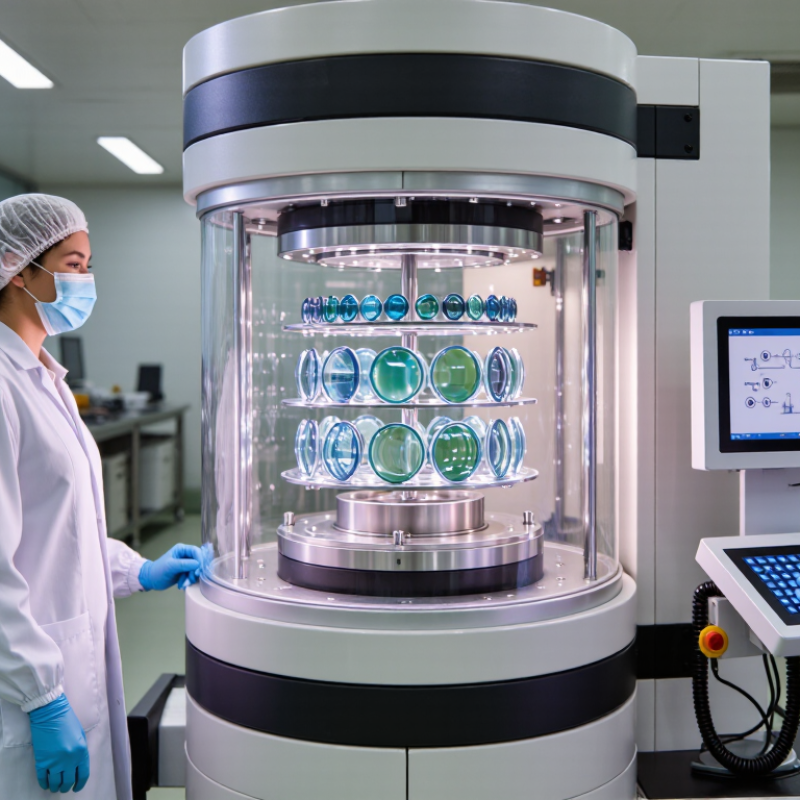
Chinese suppliers commonly produce anti-reflective coatings through vacuum deposition, with magnetron sputtering and electron-beam evaporation among the established processes. Sputtering can create dense, durable layers, while evaporation offers flexibility for many optical designs. Some production lines use ion-assisted deposition to improve film packing and adhesion. The best choice depends on the substrate, wavelength range, and service conditions.

A typical workflow starts with careful cleaning of glass or plastic substrates. Even a faint residue can affect adhesion or leave visible defects. During deposition, technicians monitor layer thickness using optical or quartz-based controls, then inspect reflectance across the specified wavelength range.

Small details matter.

For a camera lens, performance at visible wavelengths may be the priority; for an industrial sensor, a narrower band may matter more. Suppliers may also test abrasion resistance, humidity response, and coating uniformity across a batch.

Ask for actual test conditions, not just a durability claim. Process capability varies between facilities, and a polished sample does not guarantee consistent production.

One limitation is easy to overlook: complex shapes can make uniform coating thickness harder to achieve. A trial run on the intended part can reveal issues before volume production begins.

How to Evaluate ARC Coating Technology Suppliers in China

When evaluating ARC coating technology suppliers in China, match their process to your actual substrate and optical targets. Ask whether they coat glass, plastic, or another material similar to yours. A supplier’s experience with one substrate does not guarantee stable results on another. Request details about layer design, usable part size, and expected reflectance across your required wavelength range.

Review test reports, but check how measurements were taken. Ask for the instrument type, measurement locations, and sample size. A single reading may hide uneven performance across a large panel. Request coated samples and inspect them under consistent lighting for color shift, pinholes, scratches, and edge variation. Look closely. Also ask how adhesion and environmental durability are assessed, and whether the methods fit your product’s operating conditions.

Production controls matter as much as laboratory results. Ask how batches are identified, how coating parameters are recorded, and what happens when a batch falls outside specification. Clear answers are useful; vague promises are not. A polished brochure proves little. Compare lead times, minimum order quantities, packaging, and technical response speed using the same written requirements. I would still leave room for trial runs: real parts can reveal handling issues that sample coupons miss. Not every supplier will share every process detail, but traceable test data and candid limits make comparison more reliable.

Best ARC Coating Technology Suppliers in China — How to Evaluate ARC Coating Technology Suppliers in China

Compare suppliers against the wavelength range required by your application. These approximate conventional optical bands are reference ranges, not supplier performance data; exact boundaries vary by application and standard.

Ask suppliers for reflectance test reports across your specified wavelength range, together with test conditions, substrate details, and measurement methods.

Leading Chinese Suppliers and Their Technical Capabilities

Best ARC Coating Technology Suppliers in China

Leading Chinese suppliers distinguish themselves through process control, not simply coating claims. Strong teams can design single-layer or multilayer anti-reflective coatings for glass, lenses, and photovoltaic covers. Their capabilities often include vacuum deposition, substrate cleaning, thickness monitoring, and adhesion testing. Ask for spectral-reflectance curves across the working wavelength range, not a single “low-reflection” figure. A useful qualification package also shows uniformity across the coated surface and performance after humidity or abrasion tests.

Demand is growing. The International Energy Agency’s Renewables 2024 report says renewable capacity additions reached nearly 510 GW in 2023, with solar PV accounting for about three-quarters. This growth increases the value of coatings that reduce front-surface reflection on solar glass. However, suppliers’ results are difficult to compare when test conditions differ. A coating measured at one angle may perform differently under oblique sunlight. That detail is easy to miss.

Tips: Request samples from the intended substrate and compare them using the same spectrophotometer, angle, and wavelength range. Check batch-to-batch data, too. A polished sample is not proof of stable production. Some capability statements remain vague; treat them as questions for verification, not guarantees.

Industry Trends Shaping China’s ARC Coating Market

China’s anti-reflective coating market is moving toward application-specific performance rather than one coating for every surface. Suppliers increasingly work with optical glass, display panels, camera components, and solar materials, each with different wavelength and durability needs. A coating that performs well under indoor lighting may behave differently in direct sunlight. That detail matters.

Manufacturing improvements are also shaping the market. More precise vacuum deposition and in-line monitoring can help control layer thickness across a batch. Buyers should still ask how suppliers test reflectance, adhesion, abrasion, and humidity resistance. A low reflection reading alone can mislead. Sample testing on the actual substrate is more useful than relying only on a standard data sheet.

Energy use and material efficiency are receiving greater attention, though progress varies between factories. Some projects now weigh coating performance against process time, defect rates, and waste. This trade-off is not always easy. Custom development may improve fit, but it can add testing time and cost. For procurement teams, clear specifications and repeatable inspection records remain practical signs of technical capability.

Go to Top