
Blog

Best Reflow Machine Manufacturers in China?

Choosing the best Reflow Machine manufacturers in China takes more than comparing prices or polished product photos. A reliable evaluation looks at how a machine performs on real production boards, not only what its brochure promises. Ask about temperature uniformity, conveyor stability, heating zones, nitrogen options, and support for your required throughput. Small details matter.

A practical comparison should also consider factory testing, installation guidance, spare-part access, and the clarity of technical documentation. Request a live demonstration using a representative PCB, then review the thermal profile and ask how the supplier handles process changes. A low quotation may not include commissioning or ongoing support, so confirm what is covered in writing. Even a strong manufacturer may not suit every production line.

There is no single best choice for every buyer. One factory may offer flexible configurations, while another may provide faster service or clearer process advice. A polished presentation can still leave important questions unanswered. That deserves attention. This guide introduces selection criteria for comparing Chinese manufacturers and identifying claims that need verification. Use it as a starting point, then confirm specifications, references, and service arrangements directly with each supplier. A little uncertainty remains until the machine is tested with your boards.
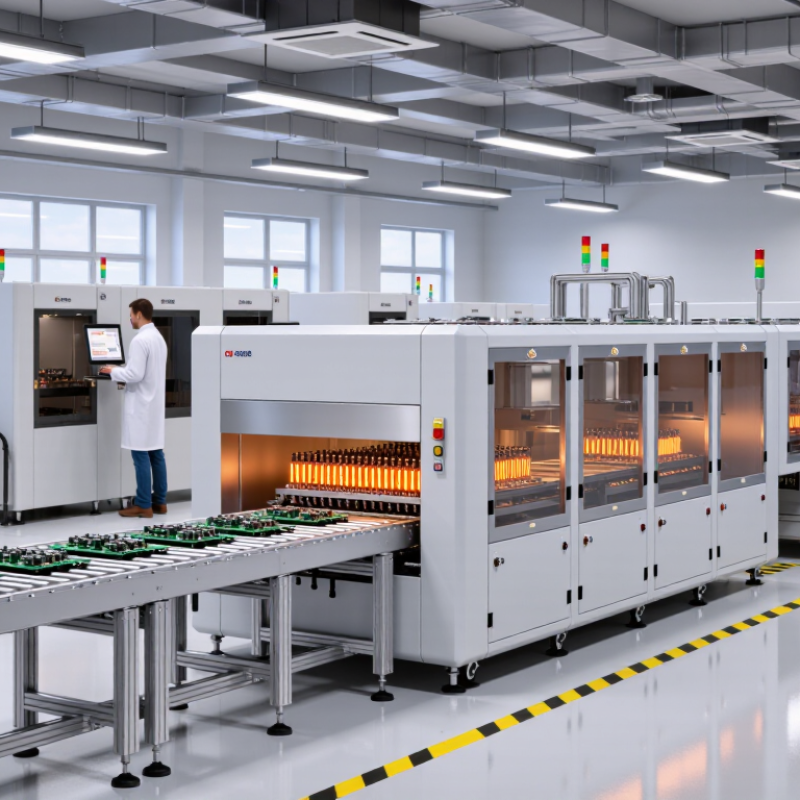
Best Reflow Machine Manufacturers in China?

What Reflow Soldering Does in Surface-Mount PCB Assembly

Best Reflow Machine Manufacturers in China?
What Reflow Soldering Does in Surface-Mount PCB Assembly

Reflow soldering bonds surface-mount components to a printed circuit board using solder paste and controlled heat. A printer deposits paste through a stencil, components are placed, and the board travels through heated zones. The paste melts, wets the pads and component leads, then solidifies into electrical and mechanical connections. Small details matter. A misplaced thermocouple or uneven heating can hide a cold joint beneath a large connector.

The temperature profile—not simply the oven’s setpoint—guides reliable results. IPC-7530 provides industry guidance for profiling reflow processes, including measuring temperatures on representative assemblies. IPC J-STD-005 classifies Type 3 solder powder as 25–45 μm and Type 4 as 20–38 μm. These particle sizes influence paste behavior during printing; they do not, by themselves, guarantee a good joint. Heat is not uniform. A profile that works on a simple board may miss a thermal challenge near a shield or heavy connector.

Tips: Attach thermocouples near real solder joints, including the board’s coolest and warmest areas. Record the profile after changing board layout, paste, or conveyor speed. Check the joints under magnification. A clean-looking surface can still conceal a defect.

Reflow Soldering in SMT PCB Assembly: Typical Lead-Free Profile

Reflow soldering heats solder paste until it melts and forms electrical and mechanical joints between surface-mount components and the PCB. This illustrative profile reaches a peak of 245°C and spends about 60 seconds at or above the 217°C liquidus temperature. Actual settings depend on the solder paste, PCB, components, and oven; follow their specifications.

How Reflow Ovens Control Heat Across Multiple Process Zones

Best Reflow Machine Manufacturers in China?
How Reflow Ovens Control Heat Across Multiple Process Zones

A reflow oven manages heat through a series of independently controlled zones. Each zone has a set temperature, while the conveyor carries circuit boards through the oven at a chosen speed. This combination creates a thermal profile rather than one sudden burst of heat. Small differences matter.

In the preheat zones, the board and components warm gradually. This helps reduce thermal shock and allows flux to activate. Soak zones hold the assembly within a selected temperature range, giving heat time to spread across components of different sizes. The reflow zone then raises solder above its melting point for a controlled period. Cooling zones lower the temperature and help solidify the joints.

Operators typically check the profile with thermocouples attached to representative locations on a test board. A large connector and a small passive component may heat at different rates. If the peak is too high, components can be stressed; if it is too low, solder joints may not form properly. Conveyor speed, board loading, and airflow also affect results. A saved profile is useful, but not permanent truth. Recheck it when the board design, component mix, or production conditions change. Even careful tuning has limits, and measurement placement can miss a local hot spot.

Best Reflow Machine Manufacturers in China? - How Reflow Ovens Control Heat Across Multiple Process Zones

Use this process-focused checklist when evaluating reflow oven manufacturers in China. The temperature ranges below are common starting points for lead-free SAC soldering, not universal machine settings or a substitute for the solder paste and component specifications.

Process Zone or Capability Typical Process Reference How Heat Is Controlled What to Check When Comparing Machines
Preheat The board is warmed gradually. A commonly used profile starting point is a ramp rate of about 1–3°C per second, subject to the paste and assembly requirements. Heated air or nitrogen is regulated by zone heaters, temperature sensors, and a controller that maintains the programmed setpoint. Ask how many independently controlled heating zones are available and whether the controller supports adjustable ramp rates.
Soak A typical lead-free profile may hold the assembly around 150–180°C for a period specified by the solder paste supplier. Several zones can maintain a more gradual temperature rise and help reduce temperature differences across the board before reflow. Check whether the recipe allows separate setpoints for each zone and whether the process can be verified with a board-mounted thermocouple profile.
Reflow and peak For SAC alloys, the liquidus temperature is approximately 217°C. Peak temperatures are often around 235–250°C, depending on the paste, components, and assembly. High-temperature zones bring solder above liquidus. Closed-loop temperature control adjusts heater output to follow the programmed profile. Confirm the operating temperature range, setpoint stability, over-temperature protection, and suitability for the assembly’s thermal limits.
Cooling Cooling should be controlled to meet the solder paste and component requirements; a cooling rate near 2–4°C per second is a commonly used process reference. Cooling zones use controlled airflow or other cooling arrangements to reduce the board temperature after the peak zone. Ask whether cooling settings are adjustable and whether the machine can produce a repeatable cooling profile across the working width.
Multiple-zone temperature control Each zone contributes to the overall time-and-temperature profile. Zone count and layout vary by oven model and application. Independent zone setpoints let operators shape the heating and cooling sequence rather than relying on one chamber temperature. Compare the number of independently controlled zones, temperature adjustment range, controller interface, and recipe storage.
Conveyor and board movement Conveyor speed affects the time the board spends in each heated zone and therefore changes the resulting profile. A variable-speed conveyor coordinates board travel through the zones; some systems also support center support for heavier assemblies. Check conveyor speed adjustment, width range, board support options, and whether the stated capacity fits the intended PCB size and load.
Temperature profiling and monitoring A profile is measured on the assembly, because oven air setpoints do not equal the temperatures experienced by every component or solder joint. A profiling instrument with thermocouples records board temperatures as it travels through the oven. Ask about profiling compatibility, data export, alarm functions, and procedures for checking temperature uniformity and repeatability.
Nitrogen option Nitrogen may be used to reduce oxidation during soldering; whether it is needed depends on the process and product requirements. A nitrogen system supplies and controls gas flow in the process chamber. Oxygen monitoring can be used to check chamber conditions. If required, verify oxygen-monitoring provisions, gas-flow controls, sealing design, and expected nitrogen consumption for the intended process.
Production support and documentation Reliable production depends on a validated recipe, preventive maintenance, and consistent operating conditions. Controls, alarms, stored recipes, and maintenance access support repeatable operation and troubleshooting. Request machine specifications, installation requirements, training details, spare-parts information, and a sample profile for a representative board.

Process note: Actual profiles depend on solder alloy, paste, PCB mass and layout, component temperature limits, and production requirements. Validate the profile on the actual assembly and follow the recommendations of the solder paste and component suppliers.

Lead-Free Thermal Profiling: SAC305 Melts at 217–220°C

For buyers comparing reflow machine manufacturers in China, SAC305 profiling is a practical test of process control.

SAC305 begins melting near 217°C and becomes fully liquid around 220°C. That distinction matters. The oven’s displayed temperature is not the solder-joint temperature. Attach fine-wire thermocouples to representative joints, including areas near large components and board edges, then record the actual heating curve.

Review time above liquidus, peak temperature, ramp rate, and cooling behavior against the solder-paste and component specifications. A single peak reading is not enough.

Small detail. Stable airflow and conveyor movement also matter, especially when boards vary in size or copper density. Ask whether the machine can repeat a profile under your real production load, not only on an empty chamber.

A tidy curve on one test board can still mislead; dense boards may heat unevenly. I would not treat one successful pass as proof.

Save profile data, inspect solder joints, and adjust the recipe carefully when defects appear. Reflow results depend on the whole process, not the machine alone.

Comparing Chinese Reflow Machine Manufacturers by Key Specifications

Comparing Chinese reflow machine manufacturers requires more than counting heating zones. The WSTS Spring 2025 forecast reported that global semiconductor sales reached $627.6 billion in 2024, up 19.7% year over year. This signals expanding electronics demand, but it does not prove that any particular oven will deliver stable soldering. Buyers should compare usable conveyor width, maximum board size, heating-zone length, and stated throughput against their actual products.

Ask manufacturers for temperature-uniformity data measured across a populated board, not only inside an empty oven. Check whether the specification reports peak temperature variation and how many thermocouples were used. Oxygen control also matters for nitrogen processes; request the guaranteed ppm range under production conditions. Small details matter. A low quoted ppm value is less useful if it applies only at a slow belt speed. Compare conveyor speed, power consumption, exhaust requirements, and recipe storage as well. Request a sample profile using your board, solder paste, and target cycle time.

Service capability deserves equal weight. Confirm spare-part availability, remote diagnostics, installation support, and operator training in writing. A machine with more zones may offer finer thermal control, yet it also needs more floor space and may increase maintenance demands. Spec sheets can appear precise, but test conditions are not always comparable. Ask each supplier for the same acceptance test and raw profile data before making a shortlist.

How to Qualify Suppliers Using 30–90 s Time Above Liquidus and Service Support

Best Reflow Machine Manufacturers in China?
How to Qualify Suppliers Using 30–90 s Time Above Liquidus and Service Support

When comparing reflow machine manufacturers, ask how they validate the 30–90 second time-above-liquidus (TAL) window. Treat it as a starting range, not a universal recipe. The suitable profile depends on solder paste, board design, component limits, and production speed. Ask suppliers to run your actual assembly and share thermocouple readings from key board locations. A smooth graph alone proves little.

Check whether the trial records peak temperature, heating and cooling rates, and TAL across the board. Request repeat runs, not just one polished demonstration. Small details matter. A supplier should explain how operators can adjust zones when heavy connectors and small chips heat differently. No profile is perfect on the first pass; the useful question is how quickly the team finds and documents a stable one.

Tips: Ask for sample profile reports, training details, and response times for technical support. Confirm who helps diagnose alarms, conveyor issues, or uneven heating, and whether guidance is available remotely. Keep the answers in writing. If support sounds vague, ask for a specific example from a similar production line. That extra question may feel awkward, but it can reveal more than a showroom demo.
Go to Top